EPISODE #003 — How Fast? (Real GDP Growth Rate)
In EPISODE #001, we asked about level through GDP per capita. In EPISODE #002, we asked about scale through GDP. Now we introduce a third dimension: motion. GDP tells us where an economy stands. Growth tells us how quickly that position changes.
If GDP is a measure of economic scale, then growth is a measure of how that scale changes over time. This episode asks how quickly economies expand in real terms.
Takeaway
GDP tells us where an economy stands. Growth tells us how quickly that position changes.
Real GD growth is the year-over-year percentage change in total output, adjusted for inflation. This matters because nominal growth can increase simply from higher prices. Real growth aims to capture expansion in actual production.
To see how recent growth compares across the G7 economies, Table 1 presents real GDP growth rates for 2024, the latest common year available in the World Bank series.
As of 2024, the United States records the highest real GDP growth among the G7, while Germany shows contraction. The ranking reminds us that growth performance can differ substantially even among advanced economies.
| Rank | Country | Real GDP growth (%) |
|---|---|---|
| 1 | United States | 2.79 |
| 2 | Canada | 1.55 |
| 3 | France | 1.19 |
| 4 | United Kingdom | 1.13 |
| 5 | Italy | 0.69 |
| 6 | Japan | 0.10 |
| 7 | Germany | -0.50 |
Table 1. G7 real GDP growth, 2024.
Source: World Bank, World Development Indicators (indicator: NY.GDP.MKTP.KD.ZG).
A single-year snapshot, however, does not show how growth behaves over time. Growth rates are often volatile: recessions, recoveries, and external shocks appear as sudden drops and spikes. This longer movement is shown in Figure 1.
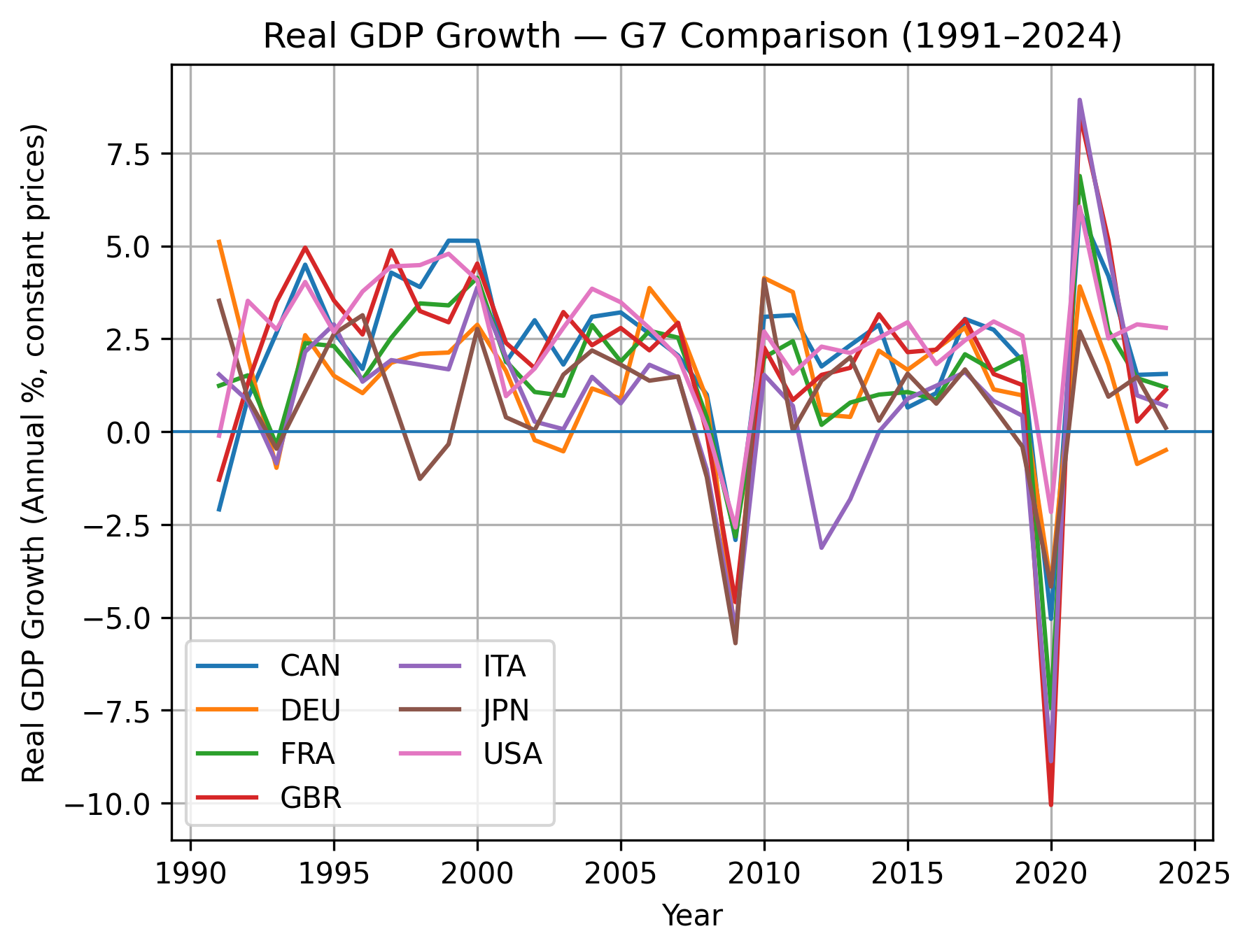
Figure 1. Real GDP growth (annual %), G7, 1991–2024.
Source: World Bank, World Development Indicators (indicator: NY.GDP.MKTP.KD.ZG).
The figure shows that growth is inherently unstable. The sharp contraction in 2009 corresponds to the global financial crisis following the collapse of Lehman Brothers. The decline in 2020 reflects the global economic disruption caused by the COVID-19 pandemic. These episodes remind us that growth is not a smooth upward line but a sequence shaped by shocks, recoveries, and structural differences.
GDP changes slowly. Growth changes quickly. Yet even small differences in growth rates, when sustained over time, can compound into large differences in economic scale.
Takeaway
Growth is the speed of the economy.
Even small differences, sustained over time, reshape global rankings and national trajectories.
Unresolved Question:
→ What makes growth sustainable, and why do some countries slow down?
Next:
EPISODE #004 — Who Works? (Employment / Labor Force)
All tables and figures on this site are generated from publicly available macroeconomic datasets.