EPISODE #001 — How Rich? (GDP per capita)
We began our journey with one of the most natural questions in macroeconomics:
How rich is each country?
A simple way to approach that question is to compare GDP per capita across countries.
Here, GDP stands for Gross Domestic Product, a measure of the total value of goods and services produced within an economy. It is often used to compare the overall size of economies (see also Glossary).
GDP per capita divides GDP by the total population. It expresses the average economic output per person and is commonly used as a proxy for income level (see also Glossary).
Takeaway
GDP per capita expressed in current US dollars mixes two things:
domestic economic production and the exchange rate used to convert it into USD.
As a result, cross-country comparisons may reflect currency movements as much as real economic differences.
But GDP per capita expressed in current US dollars is not a neutral measure. It reflects not only domestic production but also the exchange rate used to convert local output into USD.
To see how this measure compares across major economies, we can look at the GDP per capita levels of the G7 countries (see Table 1). The G7 consists of Canada, France, Germany, Italy, Japan, the United Kingdom, and the United States.
As of 2023, the United States ranks highest among the G7, maintaining a substantial gap from the other member economies.
| Rank | Country | GDP per capita (US$) |
|---|---|---|
| 1 | United States | 81,032 |
| 2 | Germany | 54,777 |
| 3 | Canada | 54,220 |
| 4 | United Kingdom | 49,944 |
| 5 | France | 44,700 |
| 6 | Italy | 39,277 |
| 7 | Japan | 33,836 |
Table 1. G7 GDP per capita (current US$), 2023.
Source: World Bank, World Development Indicators (NY.GDP.PCAP.CD).
While Table 1 provides a snapshot for 2023, it does not show how these relative positions have evolved over time. This evolution is shown in Figure 1.
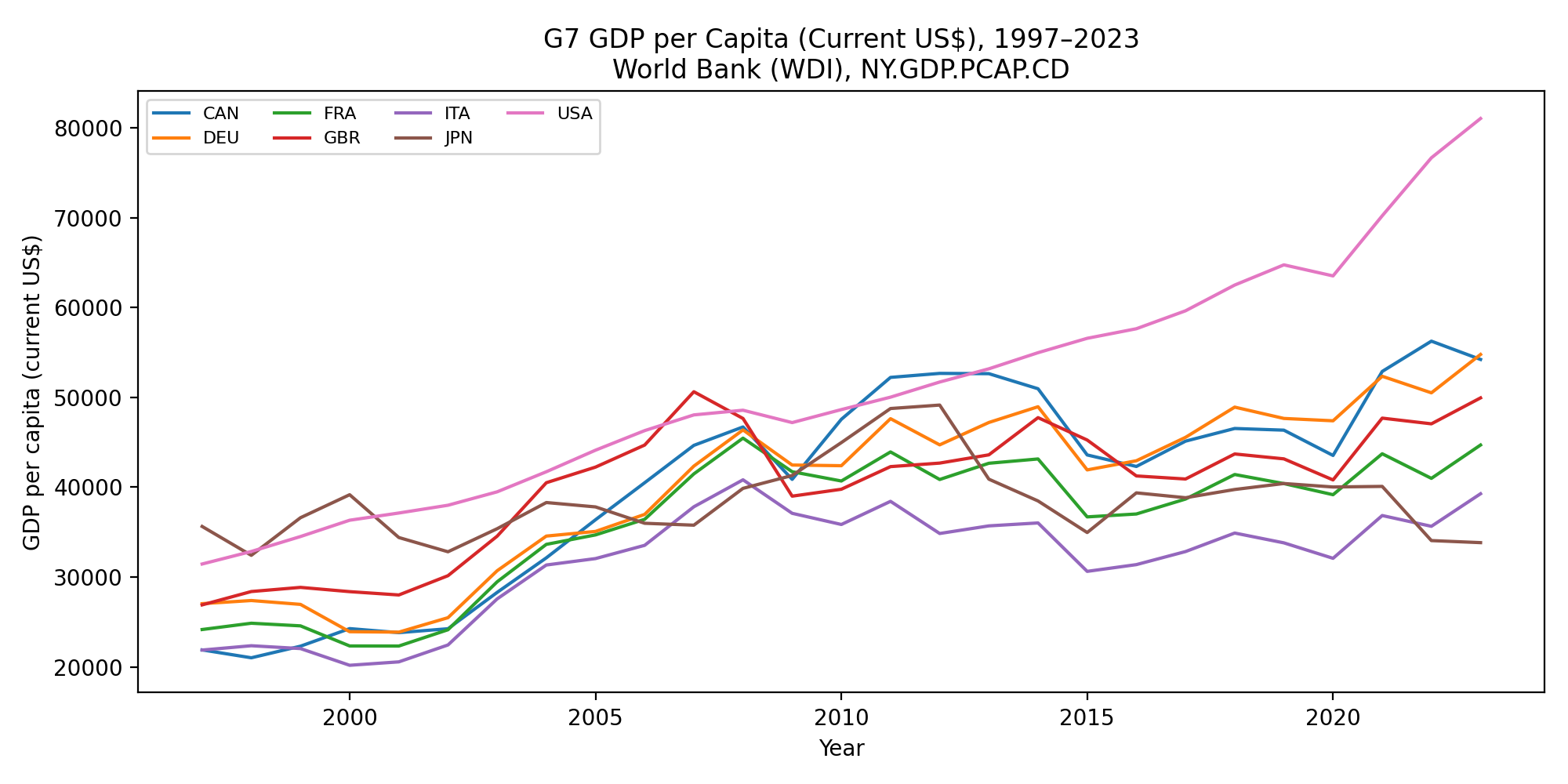
Figure 1. G7 GDP per capita (current US$), 1997–2023.
Source: World Bank, World Development Indicators (NY.GDP.PCAP.CD).
The time-series view reveals that relative positions shift over time. Exchange-rate movements can amplify or compress nominal USD values, sometimes masking smoother underlying domestic economic evolution.
Unresolved Question:
If nominal comparisons can be distorted, what deeper factors determine the economic differences we observe between countries?
Next: EPISODE #002 — How Big? (Scale and GDP)
All tables and figures on this site are generated from publicly available macroeconomic datasets.