EPISODE #002 — How Big? (Total GDP)
In EPISODE #001, we asked how rich a country is by looking at GDP per capita. Now we shift perspective. Instead of asking, How much does each person produce? we ask, How much does the entire economy produce? This is a different dimension of economic reality.
GDP per capita tells us about average output per person. GDP, viewed at the level of the whole economy, tells us about scale. An economy may be rich but small. An economy may be large but not rich per person. Some rare cases are both large and rich. These are not minor distinctions — they shape global influence.
Takeaway
GDP per capita and GDP describe different dimensions of an economy.
The first tells us about average output per person. The second tells us about the scale of the economy as a whole.
To see how economic scale compares across the G7 economies, Table 1 presents GDP in current US dollars for 2024, the latest common year available in the World Bank series. The G7 consists of Canada, France, Germany, Italy, Japan, the United Kingdom, and the United States.
As of 2024, the United States remains by far the largest economy in absolute scale among the G7. Germany ranks second, while Japan follows closely behind. The ranking differs from GDP per capita because scale depends not only on output per person but also on the total size of the economy.
| Rank | Country | GDP (trillion US$) |
|---|---|---|
| 1 | United States | 28.75 |
| 2 | Germany | 4.69 |
| 3 | Japan | 4.03 |
| 4 | United Kingdom | 3.69 |
| 5 | France | 3.16 |
| 6 | Italy | 2.38 |
| 7 | Canada | 2.24 |
Table 1. G7 GDP (current US$), 2024.
Source: World Bank, World Development Indicators (NY.GDP.MKTP.CD).
Absolute size matters because it affects what an economy can do. A larger economy generally has greater ability to absorb shocks, fund innovation, influence global financial markets, and exercise bargaining power. A small but rich country cannot project the same influence as a very large one. Size is structural power.
Takeaway
Total GDP does not tell us how wealthy people are.
It tells us how large the economic system is.
Scale and prosperity are different dimensions, and both matter.
A historical comparison helps clarify why size should not be treated as a static fact. In the late 1980s, Japan’s GDP reached a significant share of that of the United States. Today, the gap is much wider. GDP per capita alone could not fully capture that shift. Scale moves history.
This long-run change is shown in Figure 1.
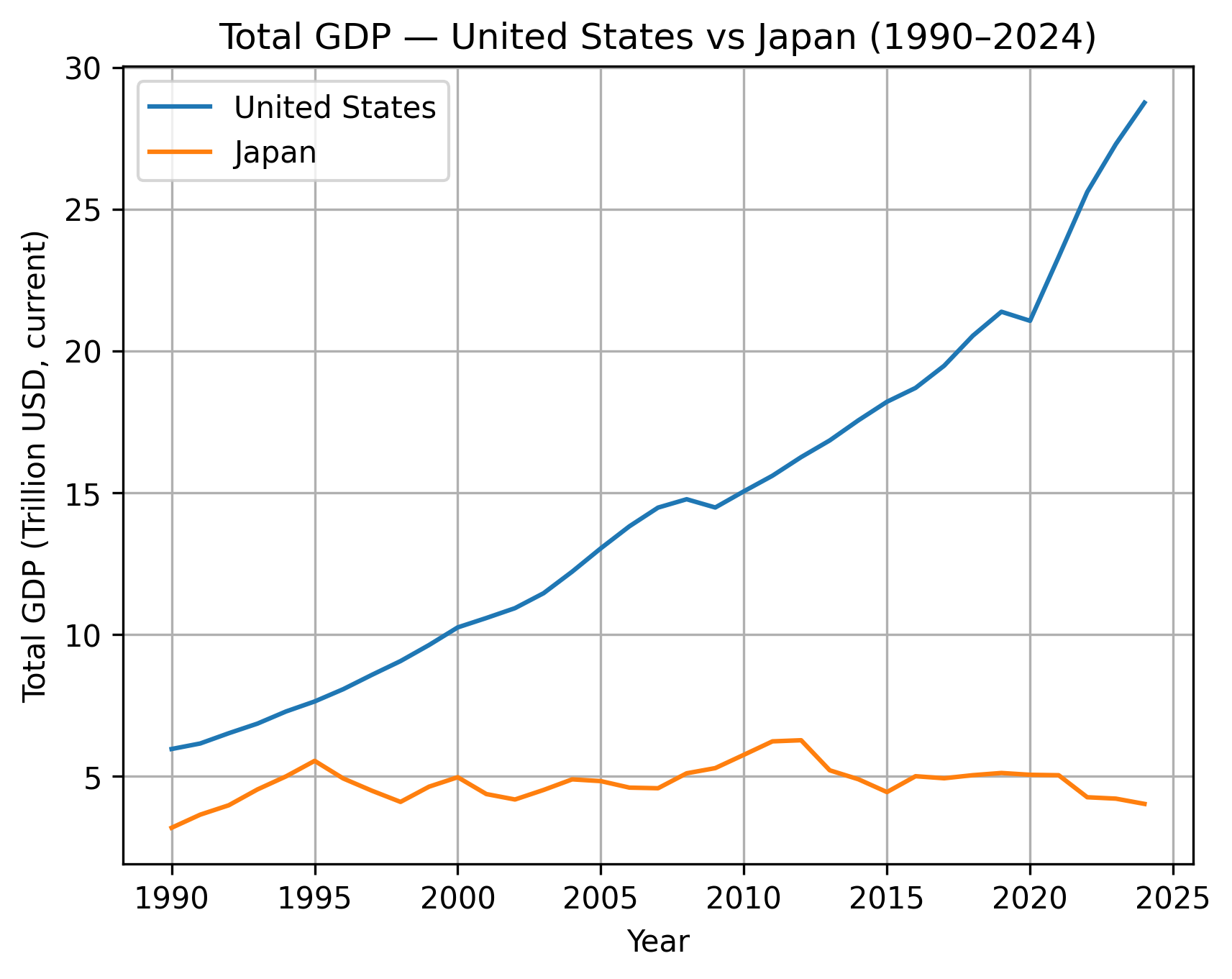
Figure 1. GDP (current US$), United States vs Japan, 1990–2024.
Source: World Bank, World Development Indicators (NY.GDP.MKTP.CD).
The figure highlights the long-run divergence in economic scale between the two economies. It reminds us that absolute size can change substantially over time, and that these changes reshape the structure of the global economy.
Let us be precise:
- GDP per capita → average output per person
- GDP → scale of the economy as a whole
Both are necessary. Neither substitutes for the other. They describe two different dimensions of economic structure.
At its simplest, the size of an economy reflects two things: how many people it has and how much each person produces. Once scale is seen this way, the next question becomes unavoidable: What makes an economy grow?
Unresolved Question:
→ What determines whether an economy becomes larger over time?
Next:
EPISODE #003 — How Fast? (Growth)
All tables and figures on this site are generated from publicly available macroeconomic datasets.